
In the United States, December 7 is one of the most solemnly remembered dates in the nation’s history. On that day in 1941, Imperial Japanese forces launched a surprise attack on the U.S. naval base at Pearl Harbor, Hawaii, drawing the United States into World War II and profoundly reshaping its role in the world.
The Attack on Pearl Harbor – December 7, 1941
At 7:55 a.m. Hawaiian time, the first wave of 353 Japanese aircraft—fighters, high-level bombers, dive bombers, and torpedo planes—struck the U.S. Pacific Fleet in Pearl Harbor and nearby airfields. A second wave arrived approximately one hour later.
In under two hours the attackers inflicted devastating losses:
- 2,403 Americans killed (2,335 military personnel and 68 civilians), including 1,177 sailors and Marines aboard the battleship USS Arizona
- Approximately 1,178–1,272 wounded (minor discrepancies exist depending on source and inclusion of lightly injured)
- 18 ships sunk, beached, or heavily damaged, including all eight battleships present
- 188 aircraft destroyed and 159 damaged on the ground
The three U.S. aircraft carriers of the Pacific Fleet—USS Enterprise, Lexington, and Saratoga—were at sea and escaped the assault unscathed, a fact that would prove critical in the months ahead.
“A Date Which Will Live in Infamy”
On December 8, 1941, President Franklin D. Roosevelt addressed a joint session of Congress. In a speech lasting just over six minutes, he declared December 7, 1941, “a date which will live in infamy.” Congress declared war on Japan that same day, with the Senate voting 82–0 and the House 388–1 (the sole dissenting vote cast by Rep. Jeannette Rankin of Montana). On December 11, Germany and Italy declared war on the United States, completing America’s entry into World War II on both the Pacific and European fronts.
National Pearl Harbor Remembrance Day
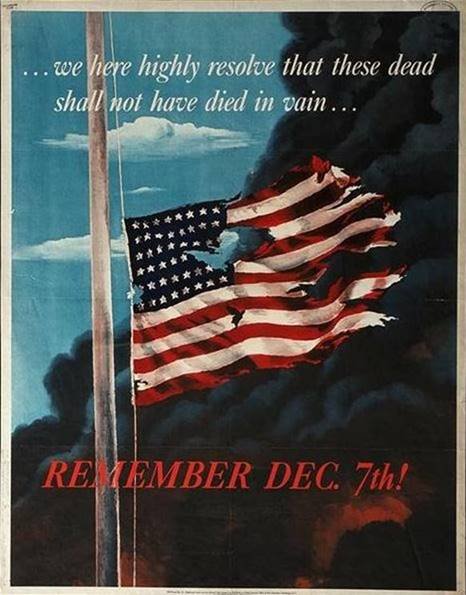
In 1994, Congress officially designated December 7 as National Pearl Harbor Remembrance Day (Public Law 103-308, signed August 23, 1994). Each year the president issues a proclamation urging Americans to observe the day with appropriate ceremonies and to honor all those who died or suffered because of the attack.
Standard observances include:
- U.S. flags flown at half-staff on federal buildings, military bases, naval vessels, and U.S. diplomatic posts abroad
- A moment of silence at 7:55 a.m. Hawaiian Standard Time (12:55 p.m. Eastern Standard Time)
- Wreath-laying ceremonies at the USS Arizona Memorial in Pearl Harbor and at memorials nationwide
The USS Arizona Memorial and Survivor Interments
The battleship USS Arizona suffered the greatest loss of life that morning. A Japanese armor-piercing bomb detonated her forward magazine, causing a catastrophic explosion that sank the ship in minutes and killed 1,177 of her crew—nearly half of all Americans lost that day. The sunken hull remains where she went down, serving as the final resting place for more than 900 sailors and Marines still entombed within.
Since 1982, the National Park Service and U.S. Navy have permitted surviving USS Arizona crew members to have their cremated remains interred inside the ship by Navy divers, reuniting them with their fallen shipmates. More than 40 survivors have chosen this honor. The last known USS Arizona crew member, Lou Conter, passed away on April 1, 2024, at age 102.
As of late 2025, fewer than ten known survivors of the Pearl Harbor attack remain alive, all over 100 years old.
A Fading but Enduring Memory
In the decades immediately following the war, December 7 was observed with a gravity comparable to Veterans Day. As the generation that experienced the attack has nearly passed, large-scale national remembrance has gradually become more localized—centered in Hawaii, at veterans’ organizations, and among military communities. For many younger Americans, the date is now most familiar through Roosevelt’s famous phrase rather than personal or family memory of the event itself.
Yet every December 7, flags are lowered, wreaths are placed, and the nation pauses to remember the morning that changed the course of the 20th century. In President Roosevelt’s enduring words, it remains a date which will live in infamy—and in the grateful memory of the United States.