
On August 7 each year, Americans observe National Purple Heart Day. This date commemorates the creation of the nation’s oldest military decoration and offers a moment for reflection on the price of liberty. For members of VFW Post 8555 and veterans everywhere, it is a day of remembrance for those wounded or killed in the service of the United States.
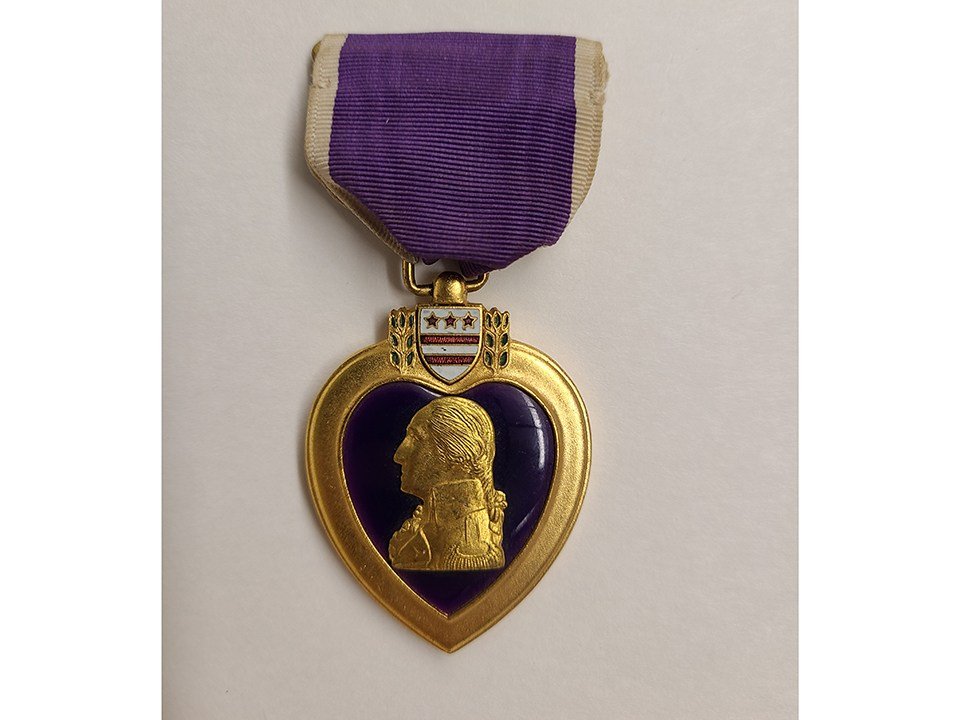
On August 7, 1782, from his headquarters at Newburgh, New York, General George Washington issued General Orders establishing the Badge of Military Merit. At a time when formal military honors were largely reserved for officers, Washington deliberately opened recognition to enlisted soldiers and non-commissioned officers. He directed that “whenever any singularly meritorious action is performed, the author of it shall be permitted to wear on his facings over the left breast, the figure of a heart in purple cloth, or silk, edged with narrow lace or binding.” Washington’s guiding principle was clear: “The road to glory in a patriot army and a free country is thus open to all.”
Only three men are known to have received the original Badge during the Revolutionary War, all Connecticut sergeants whose service exemplified the citizen-soldier ideal. Sergeant Elijah Churchill of the 2nd Continental Light Dragoons earned recognition for leading daring raids against British positions on Long Island, including the successful attack on Fort St. George in November 1780 and a later assault on Fort Slongo. His leadership helped capture prisoners, destroy supplies, and disrupt the enemy. Sergeant William Brown of the 5th Connecticut Regiment was cited for gallantry in leading a “forlorn hope” —the dangerous advance party—in the assault on British Redoubt No. 10 at Yorktown on the night of October 14, 1781, under Alexander Hamilton’s command. That action helped force the British surrender. Sergeant Daniel Bissell of the 2nd Connecticut Regiment received the badge for an extended intelligence mission behind British lines in New York City, where his fidelity, perseverance, and good sense provided valuable information to the Commander-in-Chief.
The Badge fell into disuse after the Revolution. It was revived on February 22, 1932—the bicentennial of Washington’s birth—by Army Chief of Staff General Douglas MacArthur. Redesigned as the modern Purple Heart, the medal features a bronze heart with Washington’s profile and coat of arms, suspended from a purple ribbon with white edges, and bears the words “For Military Merit.” Initially awarded for both meritorious service and wounds, the criteria were refined during World War Il. By late 1942, under President Franklin D. Roosevelt’s executive order, the Purple Heart became the decoration for those wounded or killed in action against an enemy of the United States, and eligibility was extended across all branches of the armed forces.
Estimates indicate that roughly one million Purple Hearts were awarded during World War II alone—the largest number of any conflict—reflecting the immense scale of American sacrifice in that global struggle. Across all of American history, nearly two million have been awarded. Many of the medals produced in anticipation of a possible invasion of Japan continued to be issued long after the war ended.
The Purple Heart remains a solemn symbol. It does not measure rank or length of service; it recognizes the personal cost of defending the Constitution and the ideals of liberty, self-government, and individual dignity. For recipients and their families, it marks both physical sacrifice and the enduring strength required to carry the burdens of war. On this day, VFW Post 8555 joins the nation in honoring every recipient—those who returned home and those who gave their last full measure of devotion. Their service affirms Washington’s original vision that in a free country the path of honor is open to all who answer the call.